
Nearly a year after the Trump Administration took aim at federal funding for a wide range of climate and environmental projects, legal battles continue. The last few weeks saw advocates continue to push for the full reinstatement of two key programs, FEMA’s Building Resilient Infrastructure and Communities (BRIC) program and EPA’s Environmental and Climate Justice (ECJ) Program.
First, a March 6th ruling ordered FEMA to adhere to a strict timeline under which to restart the previously at-risk BRIC program. BRIC was created in 2018 under the Disaster Recovery Reform Act and is one of FEMA’s primary tools for funding pre‑disaster mitigation efforts across the United States. Though the program pre-dates the Infrastructure Investment and Jobs Act (IIJA), its capacity expanded when the law appropriated an additional $1 billion for use over five years. In April of last year, FEMA moved to end the program and cancel previously awarded projects (Figure 1). The agency suspended the open FY2025 funding opportunity, which was poised to distribute another $750 million in awards, and announced plans to review and potentially cancel previously awarded grants.
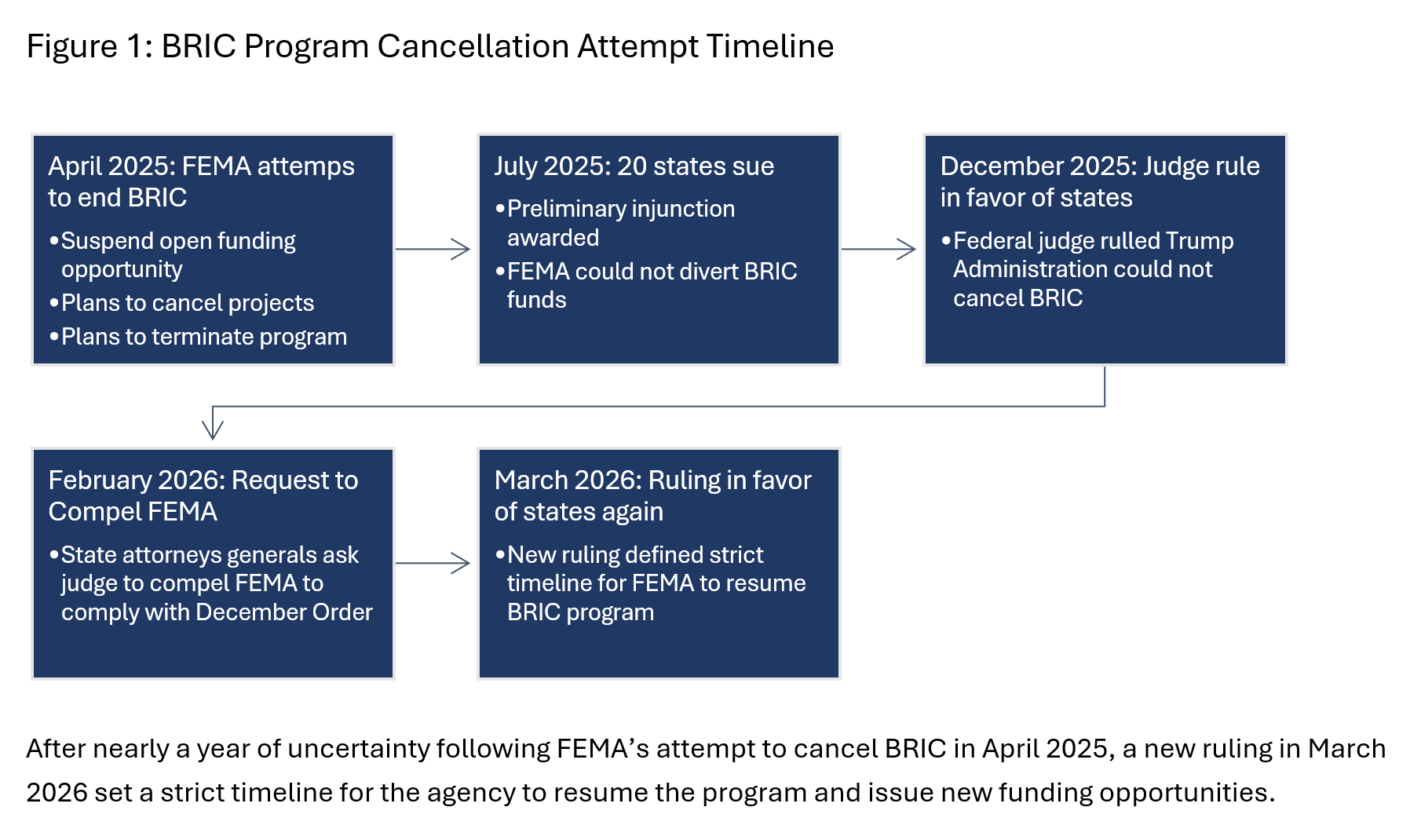
This promoted a swift response from 22 states that use this funding to support resilience projects in their communities. In August, a preliminary injunction was issued, halting the diversion of program funding to other federal accounts, and by December, a judge ruled in favor of the states, ordering that FEMA could not cancel the program and must reinstate BRIC. While the threat of canceled projects was not realized, the uncertainty and delays in funding halted urgent community infrastructure projects across the country.
According to a ruling this month, FEMA has 21 days to reinstate the previously withdrawn funding opportunity. The agency is also required to provide a status update to all BRIC grant recipients and produce a schedule for distributing the program’s FY2025 and FY2026 funding two weeks from the judicial order. Yesterday, the agency announced its intentions to relaunch a canceled grant program.
Similarly, EPA’s ECJ program was an early target of the Trump Administration, although it faces a more challenging legal battle. Created by the Inflation Reduction Act (IRA), the ECJ program was designed to advance equity in environmental protection and support communities disproportionately affected by pollution and climate change. The initiative provided $3 billion in funding for local environmental justice projects.
In early 2025, ECJ funding experienced a wave of freezes and cancellations alongside hundreds of other EPA programs. A Trump Administration memo triggered a broad halt on IRA- and IIJA‑funded programs, including environmental justice, climate, recycling, and research grants. By March 2025, EPA had announced the cancellation of over 400 climate and energy grants, a significant share of which were from the ECJ programs. Despite a federal court order on April 15th directing EPA to fully unfreeze these grants, the agency simultaneously began issuing termination notices for more than 700 EJ‑related awards, covering nearly all programs within the Office of Environmental Justice.
By August 2025, a coalition of non-profits, Tribal Nations, and local governments sued EPA over the program’s termination in a first-of-a-kind class action lawsuit. The Trump administration moved to dismiss the case on jurisdictional grounds, arguing it belonged in the U.S. Court of Federal Claims as a contract dispute that would allow only monetary damages, and in August 2025, the district court agreed and dismissed the case, directing the claims to that court. The coalition represented by Earthjustice, Lawyers for Good Government, the Southern Environmental Law Center, and the Public Rights Project is appealing that decision; earlier this week, the U.S. Court of Appeals for the D.C. Circuit heard oral arguments on whether the case can proceed in district court and potentially require restoration of the congressionally authorized grant program.
It is unclear what the outcome of the appeal will be. These lawsuits represent an important tool advocates, non-profits, and governments have used to challenge federal funding cuts and preserve the once-in-a-lifetime federal funding provided by IIJA and IRA. The Water Program Portal will continue to monitor any updates as BRIC is reinstated and the legal battle over the ECJ program unfolds.