As emerging contaminants (ECs) like PFAs and microplastics enter U.S. water systems, the federal government has responded by updating regulatory frameworks built to keep drinking water safe and establishing new federal funding to support addressing them. In 2021, the Infrastructure Investment and Jobs Act (IIJA) boosted funding for drinking water by over $50 billion. Much of this funding has supported projects through the State Revolving Funds, but an additional $5 billion was used to create a fund the Emerging Contaminants (EC) in Small or Disadvantaged Communities Grant (SDC) program. The program is squarely aimed at assisting small or disadvantaged communities (SDCs) with testing and treatment for emerging contaminants like PFAS and microplastics. New monitoring data of U.S. community water systems has shown socioeconomic disparities in exposure, with higher concentrations of PFAS in drinking water sources serving disadvantaged communities. Directing federal funds to these communities helps address these disparities, while also providing small water systems with much needed financial support.
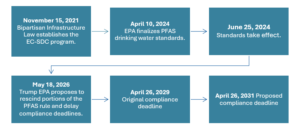
While implementing this funding, EPA enacted new drinking water standards to monitor and regulate PFAS for the first time, finalized April 26, 2024, and effective the following June. Water systems were required to test for PFAS by 2027, and meet the new standards by 2029, which in areas with PFAS, would require significant infrastructure investment to which programs like EC-SDC are intended to contribute. However, these new regulations were revisited by the Trump administration in 2026 (Figure 1). In May, EPA under Administrator Zeldin announced a proposal to rescind drinking water standards for many of the newly regulated PFAS, and extended compliance deadlines for PFOA and PFOS from 2029 to 2031. Public comment for these proposed changes closed on July 20, 2026, and the agency is expected to review feedback before finalizing the rule. 18 states (North Carolina, California, Connecticut, New Jersey, Arizona, Colorado, Delaware, Hawaii, Illinois, Maine, Maryland, Massachusetts, Minnesota, New York, Rhode Island, Oregon, Washington, and Wisconsin) and D.C. have opposed the proposed rollback, arguing it violates the Safe Drinking Water Act and the Administrative Procedure Act.
Figure 1: A Changing Regulatory Landscape for Emerging Contaminants
Source: EPA Emerging Contaminants (EC) in Small or Disadvantaged Communities Grant (SDC), EPA Final PFAS National Primary Drinking Water Regulation.
The new program supports a variety of eligible projects, including new PFAS treatment systems, drinking water infrastructure upgrades, water quality testing and monitoring, technical assistance and planning, and water system consolidation. Projects must be in small or disadvantaged communities. Small communities are defined as a small public water system serving ten thousand or fewer households, which often do not have the capacity to incur the financial debt required to build the infrastructure necessary to monitor and treat emerging contaminants. Disadvantaged communities are defined by each state’s Drinking Water State Revolving Fund (DWSRF) program, which typically include factors like median household income, the financial capacity of a water system, and environmental justice considerations in their determination.
How much was provided by IIJA for this program?
Congress appropriated $5 billion for this program via IIJA, matching the $5 billion provided for the State Revolving Funds to address emerging contaminants. Funds were allocated for federal fiscal years 2022 through 2026. The EPA announced the first round of allocations in February 2023, combining the first two years of funding; the final allocation from the IIJA appropriation was announced in May 2026. In total, about $4.5 billion has been allocated to all fifty states and Washington D.C., with additional funding supporting U.S. territories.
Funding moves to projects through the states via the following steps:
- State allocations are established by formula for each state, employing factors like population, number of water systems, and the prevalence of emerging contaminants, and announced annually by the EPA.
- States and territories may submit Letters of Intent to accept the noncompetitive awards.
- States then administer the funding locally and use the grants to support eligible projects and activities in small or disadvantaged communities.
What has been obligated?
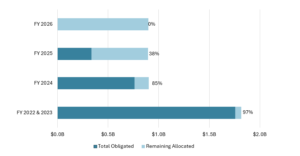
According to federal reporting on USASpending.gov, about half of all states (24) have obligated 100 percent of their allocated funding through FY2025 (Figure 3). 86 percent (43) of states have obligated 100 percent of their allocated funding through FY2024. FY2026 funding allocations will likely be obligated later this year, as they were recently announced. In total, this means nearly 80 percent of all allocated FY2022-FY2025 funding has been obligated (Figure 2). Some states have not obligated any of their available funding (Idaho and Mississippi) while others (South Dakota) have obligated very little (Figure 3).
Figure 2: Most allocated funding from FY2022-2024 has been obligated
Source: EPA EC-SDC Allotments, USASpenging.gov Prime Awards, July 13, 2026
Figure 3. Program allocations, obligations, and subawards by state
Source: EPA EC-SDC Allotments, USASpenging.gov Prime Awards, July 13, 2026
What projects have been funded so far?
Once states receive their allocated funding from the EPA, the administering agency can sub-award funding to local projects. According to USASpending.gov reporting, about 15 percent of obligated funding has been sub-awarded to 165 projects across the United States (Figure 3). Supported projects range in focus from the installation of new wells, treatment systems, and water storage to sampling and monitoring activities.
Example projects include the replacement of aging groundwater wells in which a chemical known as 1,2,3-Trichloropropane (TCP) has been detected in Wasco, California; the installation of a new filtration system to treat for PFAS in Greenwood, Indiana; and the construction of a new water supply well in Harin Township, Michigan in a PFAS-free area that will be protected from nearby contaminants and provide clean water to the local water system. Over two-thirds of sub-awards mentioned PFAS mitigation in their project descriptions, suggesting PFAS are the primary focus of early projects.
What is next?
Over the next year, EPA will continue to obligate new funding as states request their FY2026 allotments. Once distributed to states, administrators will award funding to local projects, which are expected to be completed over the next five years. Water systems can go to their state’s water agency for more information about how to apply for funding. FY2026 is the final year of funding made available through IIJA for this program, meaning the current tranche represents the last scheduled federal allocation under the original $5 billion appropriation. If states need additional support via this program to address PFAS, microplastics, and other emerging contaminants they will need Congress to appropriate new funding beyond IIJA. Later this year will also bring a decision from the EPA on the agency’s proposed PFAS regulation rollback.