Late last month, the Water Program Portal rolled out a refresh to the Outcomes Dashboard. At a high level, the dashboard now features grant termination statuses, awarded funding tracked by congressional district, and per capita funding. Additionally, the State Revolving Loan Fund tab includes updated Intended Use Plans and new filtering features to examine statuses by the federal fiscal year. Keep reading for a more detailed description of the platform’s changes.
Overview Tab
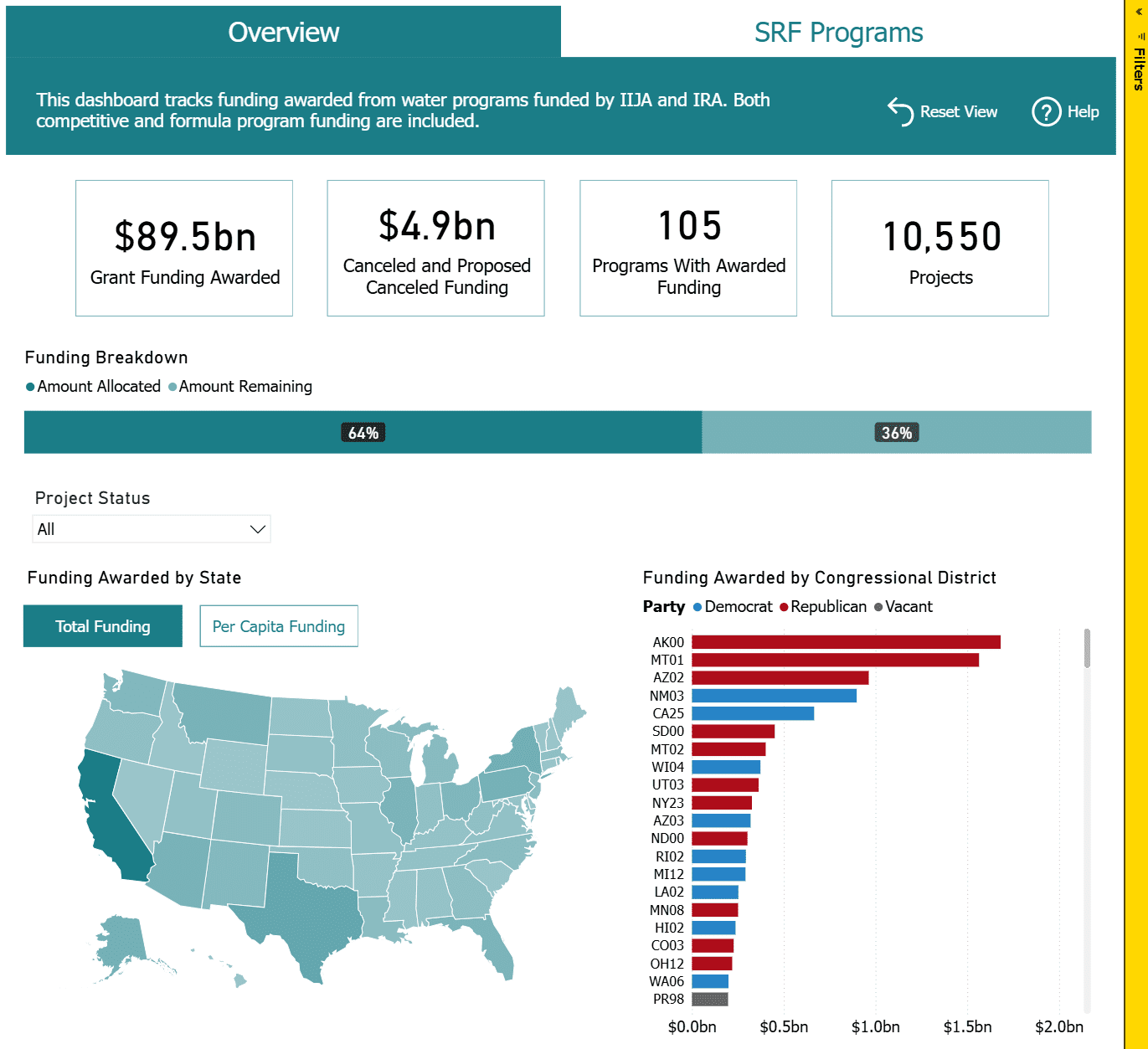
A new KPI at the top of the dashboard displays the total amount of proposed canceled and officially canceled grants within the Water Program Portal’s purview. As of writing, the dashboard tracks about $89.5 billion in awarded grant funding and $4.9 billion in proposed canceled and canceled grants. Programs whose funding are described as proposed canceled are in limbo in some way. For instance, the Trump administration’s Environmental Protection Agency has released public statements describing their cancellation of these grants, like the agency’s suite of environmental justice grant programs; other programs were canceled in the text of the One Big Beautiful Bill, such as the $2.6 billion Investing in Coastal Communities and Climate Resilience program.
However, because much of that funding has already been legally obligated to the program’s awardees, we are awaiting confirmation from grantees, clarity from administering federal agencies, and in some cases, settled lawsuits before confirmed what has been officially clawed back. As a result, the funding is described as proposed canceled or targeted for cancellation. Users can toggle between all awarded grants and those that are facing cancellation near the bottom of the Overview Tab.
The map on the Overview tab now also contains a toggle to display awarded funding per state on a per capita basis, in addition to the existing total funding display. Furthermore, clicking on a state displays the funding awarded to each congressional district in the state, as well as the political party of the representative for that congressional district. This analysis is available for grants localized enough that they fall within a congressional district, and as a result excluded statewide and multi-state awards.
Retained on the Overview Tab are bar graphs showing funding awarded by each program as well as by each water policy area. As always, users are able to interact directly with the dashboard’s visualizations. Clicking on one graphic and control clicking on one or more other graphics crosscuts the visualizations and the KPIs displayed specifically for those selections. For instance, clicking on the state of Colorado and then control clicking on congressional district CO03 and water policy area flooding displays all the awards and proposed canceled awards in CO03 from the programs within the flooding policy area.
SRF Programs Tab
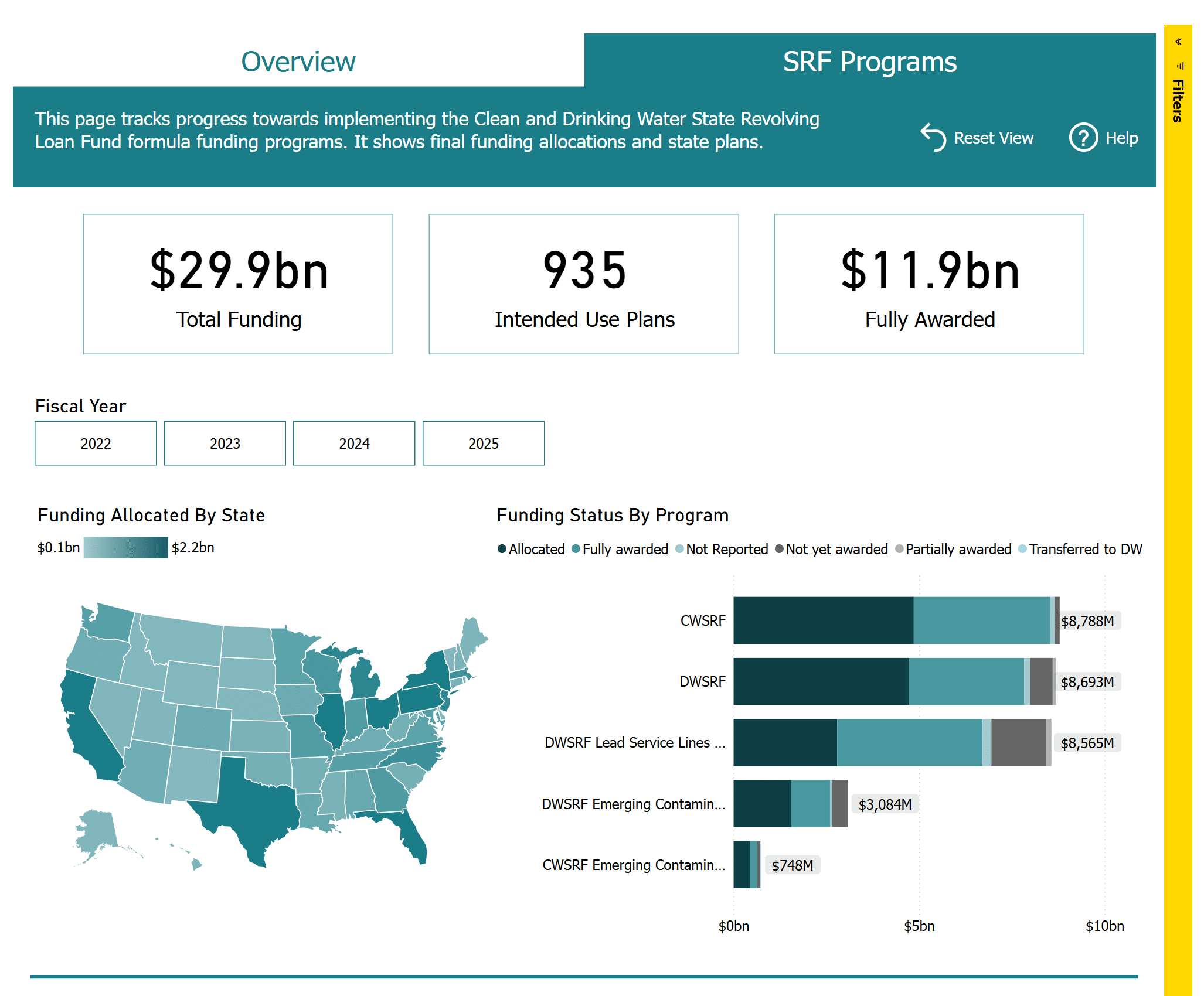
The SRF Programs tab has been overhauled to provide more information regarding the implementation of the two Clean Water State Revolving Loan Fund (CWSRF) programs and the three Drinking Water State Revolving Loan Fund (DWSRF) programs. With the addition of fiscal years 2025 Intended Use Plans (IUPs) , a more comprehensive picture of what funding has been awarded where is displayed.
The SRF Programs Tab now also describes the status of funding flowing from each of the five programs: allocated, fully awarded, partially awarded, transferred, not awarded, and not yet reported. Again, by interacting with the visualizations on the dashboard, users may filter to examine funding statuses by the fiscal year, state, funding status, and specific SRF program.
At the bottom of the page lies one table summarizing funding amounts by state and a second table with direct links to states’ IUPs on a fiscal year and program by program basis. IUP availability statuses vary. For instance, some states’ applications to lead service line replacement or emerging contaminants SRF programs did not begin in fiscal year 2022; they applied for that funding in IUPs for future fiscal years. Additionally, because many states date their IUPs according to the state fiscal years, their IUPs are sometimes finalized after the federal fiscal year has passed.
The Water Program Portal will keep this information as up to date as possible with regular sweeps of state agencies managing the SRF programs and monitoring of grant awards and potential cancellations.